
What Gets Checked in a Roadworthy Inspection? The Complete RWC Checklist

Updated: Feb 4
Selling your car? Transferring registration? You'll need a roadworthy certificate (RWC) – and if you've never had one done before, you're probably wondering what actually gets inspected.
The good news: a roadworthy isn't as scary as it sounds. It's a safety check, not a full mechanical inspection. The focus is on whether your car is safe to drive on public roads – not whether it's in perfect condition.
Here's exactly what gets checked, the most common reasons cars fail, and how to give yourself the best chance of passing first time.

🔍 What Is a Roadworthy Certificate?
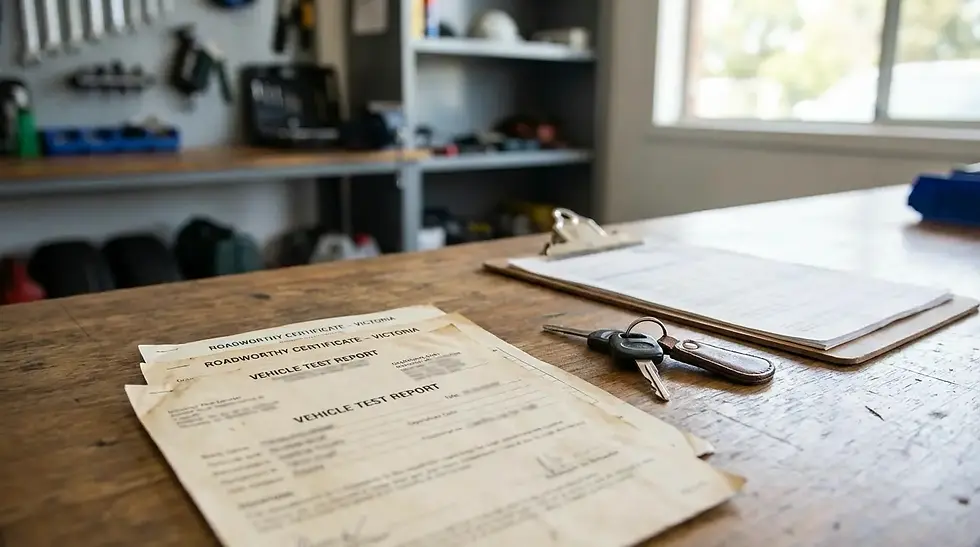
A roadworthy certificate (also called an RWC) is an official document confirming your vehicle meets minimum safety standards for Victorian roads. It's issued by licensed vehicle testers after a physical inspection.
You'll need one when:
Selling a registered vehicle
Transferring ownership to a new buyer
Re-registering a vehicle that's been unregistered
Clearing a defect notice (that yellow or red sticker)
An RWC is valid for 30 days from the date of issue. After that, you'll need a fresh inspection if you haven't completed the sale or transfer.
✅ The Complete Roadworthy Checklist
Here's what the inspector will check during your roadworthy inspection:
Brakes & Braking System
Brake pedal feel and travel
Handbrake operation and holding ability
Brake pads and rotors (disc brakes)
Brake drums and shoes (drum brakes)
Brake lines and hoses for leaks or damage
Brake fluid level
Tyres & Wheels
Tread depth (minimum 1.5mm across the full width)
Tyre condition (no cuts, bulges, or exposed cords)
Correct tyre size for the vehicle
Wheel nuts tight and present
No cracks or damage to wheels
Steering & Suspension
Steering wheel play (shouldn't be excessive)
Power steering operation and fluid
Suspension components (shocks, struts, bushings)
CV joints and boots
Ball joints and tie rod ends
Lights & Electrical
Headlights (high and low beam)
Tail lights and brake lights
Indicators (front, rear, and side)
Hazard lights
Number plate lights
Dashboard warning lights
Body & Structure
Rust that affects structural integrity
Chassis and body condition
Doors open, close, and latch properly
Bonnet and boot latches secure
Windscreen & Glass
No cracks in the driver's line of sight
Windscreen wipers working and in good condition
Washer fluid sprays correctly
All mirrors present and secure
Seats & Seatbelts
Seatbelts retract and lock properly
No fraying or damage to belt webbing
Seat anchors secure
Driver's seat adjusts and locks in position
Exhaust System
No leaks or excessive noise
Securely mounted
Emissions within acceptable limits

🚨 Common Reasons Cars Fail Roadworthy Inspections
After thousands of inspections, these are the issues we see most often:
Tyres – Worn tread is the number one fail point. If your tyres are getting close to 1.5mm, they won't pass. Uneven wear patterns can also be a problem, often pointing to alignment issues or worn suspension.
Windscreen chips and cracks – A small chip outside the driver's vision might pass, but anything in the swept area of the wipers usually won't.
Brake pad wear – Pads that are too thin or rotors that are scored or warped will fail. If you hear grinding or squealing, get your brakes checked before the inspection.
Suspension wear – Worn bushings, leaking shocks, or damaged CV boots are common on older vehicles.
Lights not working – Blown globes are an easy fix, but people often forget to check all their lights before the inspection.
Seatbelt issues – Belts that don't retract properly or have damaged webbing will fail every time.

💡 How to Prepare Your Car for a Roadworthy
Want to maximise your chances of passing first time? Do these checks before you book:
Walk around the car – Check all lights are working (get someone to press the brake pedal while you watch). Look at your tyres for obvious wear or damage.
Test the basics
Wipers, washers, horn, seatbelts. Make sure everything clicks, locks, and works as it should.
Check under the bonnet
Look for obvious leaks, check fluid levels, and make sure the battery is secure.
Listen while driving
Any unusual noises from brakes, suspension, or steering? Get them checked first.
Look at your windscreen
Chips and cracks in the wrong spot will fail you. Get them repaired beforehand if needed.
Check your tread depth
The legal minimum is 1.5mm, but if you're close, you might want to replace your tyres before the inspection rather than risk a fail.
Got questions about whether something will pass?
We're happy to take a look before your official inspection – better to know upfront than waste money on a fail.

📍 Where to Get a Roadworthy Certificate in North-East Victoria
Not every mechanic can issue roadworthy certificates – you need a licensed vehicle tester (LVT). At Ynot Auto, we're fully licensed to conduct roadworthy inspections and issue certificates on the spot.
If your car needs repairs to pass, we can handle those too – no need to go elsewhere and come back. Most inspections take under an hour, and if everything's in order, you'll drive away with your certificate the same day.
We inspect cars, utes, 4WDs, and light commercial vehicles at our workshops in Benalla, Yarrawonga, and Mulwala.

❓ Frequently Asked Questions
Q: How long does a roadworthy inspection take?
A: Most inspections take 30-60 minutes. If your car passes, you'll have your certificate the same day. If repairs are needed, timing depends on what's required.
Q: How much does a roadworthy certificate cost?
A: Costs vary, but expect to pay between $150-$200 for a standard vehicle inspection. Give us a call for current pricing.
Q: What happens if my car fails the roadworthy?
A: You'll receive a report listing what needs to be fixed. Once repairs are done, you'll need a re-inspection (usually at a reduced fee) to get your certificate.
Q: How long is a roadworthy certificate valid for?
A: 30 days from the date of issue in Victoria. If you don't complete the sale or transfer within that time, you'll need a new inspection.
Q: Is a roadworthy the same as a safety certificate?
A: In Victoria, it's called a roadworthy certificate (RWC). In Queensland, it's a safety certificate. They check similar things but are issued under different state regulations.


Comments